Securing a private water source is one of the most effective ways to increase the value of a property in Tanzania. Whether you are developing a residential plot, a commercial building, or a farm, a borehole provides long-term water security and significantly reduces monthly utility bills. However, borehole drilling is a technical and capital-intensive project that requires careful financial planning. This guide provides a detailed breakdown of the costs associated with borehole drilling and pump installation in Tanzania from a Quantity Surveyor's perspective.
Key Factors Influencing Borehole Costs
In Tanzania, no two borehole projects are identical in cost. Several geological and logistical variables will determine your final budget:
- Geological Formation: Drilling through hard rock (basalt or granite) requires different bits and more time compared to drilling through soft sand or clay, which impacts the hourly or per-meter rate.
- Drilling Depth: Costs are generally calculated per meter. In coastal regions like Dar es Salaam or Bagamoyo, water tables may be found at 60–80 meters, while in dry inland regions like Dodoma or Singida, you may need to drill 120–200 meters.
- Borehole Diameter: A standard domestic borehole is usually 4 to 6 inches. Commercial or industrial boreholes requiring higher volumes need larger diameters, increasing casing and drilling costs.
- Site Accessibility: The cost of "mobilization" (bringing the heavy drilling rig to your site) depends on how far the site is from the contractor's base and how accessible the terrain is.
Phase 1: Pre-Drilling and Legal Requirements
Before the rig arrives, there are mandatory professional and legal steps. Skipping these can lead to "dry holes" or legal fines from Water Basin Authorities.
- Geological/Geophysical Survey: A professional hydrogeologist uses resistivity meters to locate the best spot to drill. This reduces the risk of drilling a dry well. (Estimated Cost: TZS 400,000 – TZS 800,000).
- Water Use Permits: You must obtain a permit from the relevant Basin Water Board (e.g., Wami-Ruvu, Pangani, or Lake Victoria Basin). These permits ensure your drilling is environmentally compliant. (Estimated Cost: TZS 200,000 – TZS 500,000 depending on use type).
Phase 2: Drilling and Casing Materials
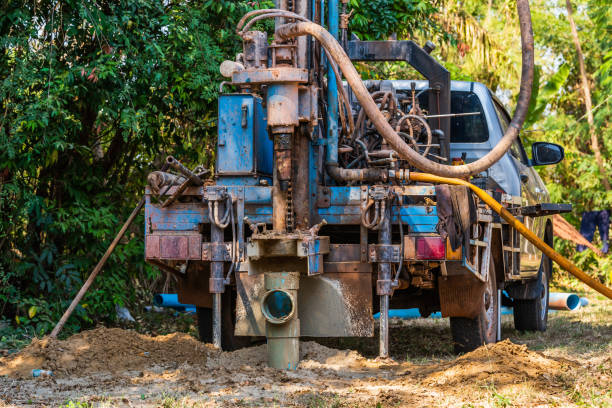
This is the most expensive phase of the project. It includes the actual penetration of the ground and the reinforcement of the hole to prevent collapse.
- Drilling Charges: Most contractors in Tanzania charge between TZS 100,000 and TZS 180,000 per meter. This price often includes mobilization and "drilling only."
- Casing Pipes (uPVC): These pipes line the hole. "Screen" casings have slots to allow water in, while "Blind" casings are solid. High-pressure Class 10 or Class 12 pipes are recommended for durability.
- Gravel Pack and Grouting: Fine gravel is poured around the casing to act as a natural filter, while cement grouting at the top prevents surface water contamination.
Phase 3: Pump Installation and Testing
Once the hole is drilled, a "test pumping" exercise is conducted for 24 hours to determine the "yield" (how much water the well produces) and the "drawdown" (how the water level drops). This data determines the size of the pump needed.
| Item Description | Average Cost (TZS) | Notes |
|---|---|---|
| Submersible Pump (Electric) | 1,200,000 - 3,500,000 | Depending on Horsepower (HP) and Head (m). |
| Solar Pump System | 4,500,000 - 8,000,000 | Includes panels, inverter, and structure. |
| Control Box & Sensors | 350,000 - 600,000 | Protects pump from dry-run and surges. |
| Submersible Cable (per meter) | 8,000 - 15,000 | Must be water-proof and correct gauge. |
| Piping (Delivery/Rising Main) | 15,000 - 25,000 | PN16 or Stainless steel sections. |
Estimated Total Project Budget
Based on current market trends in Tanzania, here are three general budget scenarios:
- Budget Scenario A (Coastal - 80m Depth): Total project cost ranges between TZS 8,500,000 and TZS 11,000,000 using a high-quality electric pump.
- Budget Scenario B (Inland/Hard Rock - 120m Depth): Total project cost ranges between TZS 13,000,000 and TZS 17,000,000.
- Budget Scenario C (Solar-Powered System): Expect to add an extra TZS 3,000,000 to TZS 5,000,000 to the above scenarios for the solar array and specialized DC pump.
Frequently Asked Questions (FAQs)
1. How long does a borehole last?
A professionally drilled and cased borehole can last for 25 to 50 years. The longevity depends on the quality of casing pipes used and regular maintenance of the submersible pump.
2. Is solar better than electricity for a borehole pump?
While the initial cost of a solar pump is much higher, it is "better" for long-term savings because there are no monthly electricity bills. Solar is also ideal for remote locations where the national grid (TANESCO) is unavailable or unreliable.
3. Can I drill a borehole anywhere in my compound?
No. A survey is required to find the water-bearing fracture (aquifer). Additionally, environmental regulations in Tanzania require boreholes to be at least 15 to 30 meters away from septic tanks or pit latrines to prevent contamination.
4. What happens if the driller does not find water?
This is known as a "Dry Hole." Most contractors have a "dry hole" clause in their contracts where you still pay for mobilization and the actual meters drilled, though at a slightly lower rate. This is why a professional geological survey is mandatory to minimize risk.
Expert Recommendations for Property Owners
To ensure a successful borehole project, always hire a company registered with the Contractors Registration Board (CRB) and the Ministry of Water. Request a formal Bill of Quantities (BQ) that specifies pipe classes and pump brands (e.g., Grundfos, Pedrollo, or Dayliff). Avoid contractors who offer prices that are significantly lower than the market average, as they often use thin-walled pipes that collapse after a few years, leading to the total loss of the borehole.